


News
BIO Partners with Vending Machine for Token Design and Economic Simulations.
Announcing our partnership with BIO, a new financial layer for decentralised science.

AMMs are DeFi's clearest product-market fit. Today, a single pair routinely trades across several pools, each set to its own static fee tier.
On the WETH/USDC pair on Base, one tier dominates in calm markets; a different one captures flow when volatility spikes. Neither is optimal in both regimes. In March 2025, Aerodrome shipped a dynamic fee model on its Slipstream pools that adjusts the fee block-by-block based on realized volatility.
Dynamic fees outperform any single static tier across market conditions. They also collapse the liquidity fragmentation that comes with multi-tier designs. We examined 90 days of flow on Base across Aerodrome's dynamic-fee Slipstream pools, Uniswap v3 (5 bps and 30 bps), and PancakeSwap v3 (1 bps), measuring volume capture, fee revenue, routing accuracy, and transaction failure rates.
Aerodrome's Slipstream v2 dynamic fee is a function of four parameters.
A base fee, a fee cap, a scaling factor that amplifies measured volatility into a fee delta, and a lookback window that sets the time-weighted average tick for the volatility calculation. The fee at any block equals the base fee plus times the realized volatility over the lookback, clamped to the cap.
The design draws on two lines of academic work. Milionis et al. (2023) showed that arbitrage profits with fees scale with the probability of a profitable arb in any given block, itself a function of volatility, fee rate, and block arrival rate. A 2025 paper on optimal dynamic fees confirmed that linear fee structures conditioned on liquidity and external price closely approximate the theoretical optimum and outperform static fees across both constant and stochastic price scenarios. Aerodrome's model is the first major production deployment of these findings.
The formula is simple - a volatility-scaled fee between a floor and a ceiling - but ongoing parameter optimisation space (, , , ) is where all the alpha lives.
We measured volume share for low, medium, and high static fee tiers and for dynamic-fee pools, across calm, moderate, and turbulent conditions on Base. The pattern is consistent.
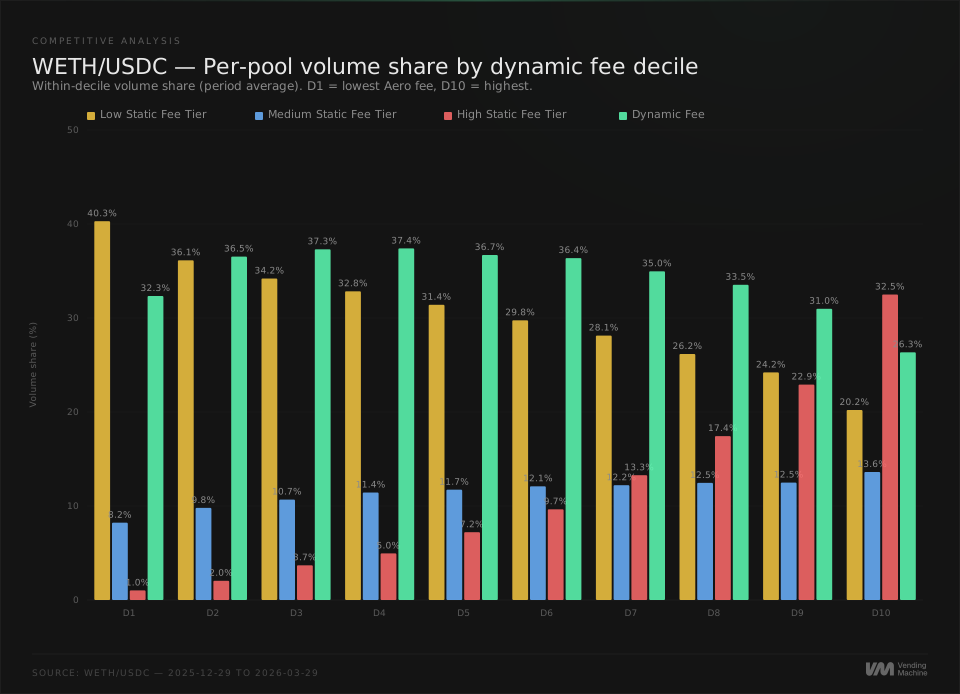
D1-D10 are deciles of measured volatility over the observation window. We segmented the 90-day series into 5-minute intervals and sorted them into 10 buckets of equal count, ranked low to high.
In calm markets, volume is fee-sensitive. Low-fee pools win the flow but earn thin LP revenue.
When volatility rises, the fee rate becomes a weaker predictor of volume capture, which lets higher-fee pools pull flow. High-fee pools are dead weight in calm markets and only activate during volatility spikes.
No single static tier maximizes fee revenue across both regimes. Dynamic fee exploits this asymmetry directly: it compresses fees in calm conditions to win the fee-sensitive flow and expands them in turbulent conditions to capture the surplus that static low-fee pools leave behind.
Dynamic fees compete against every static tier simultaneously. No single static pool can do that.
Static fee tiers force LPs into a portfolio allocation problem. Liquidity in the 1 bps pool earns on calm-market flow but misses the turbulent-market premium. Liquidity in the 30 bps pool sits idle during low-vol stretches and only activates when volatility spikes. Split capital across both and you fragment your own book, widening effective spreads on each.
Dynamic fees collapse the choice into a single pool. LPs get the combined reward profile of multiple static tiers without splitting capital. For traders, the benefit is direct: aggregated liquidity in one pool means lower slippage across all market conditions versus the fragmented depth of a multi-tier design.
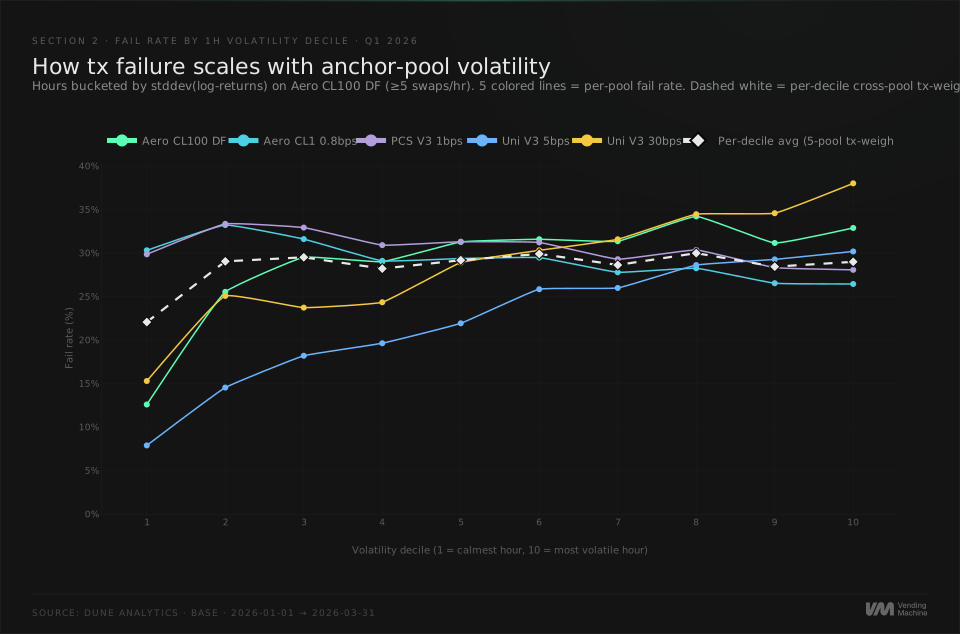
One objection to dynamic fees: unpredictable fee paths raise transaction failure rates. That matters for tight-margin strategies and for aggregator integrations.
The data does not support the objection. Over the 90-day sample on Aerodrome's CL100 pool, volume is not structurally undersubscribed on a net execution cost (NEC) basis versus the Uniswap 30 bps pool.
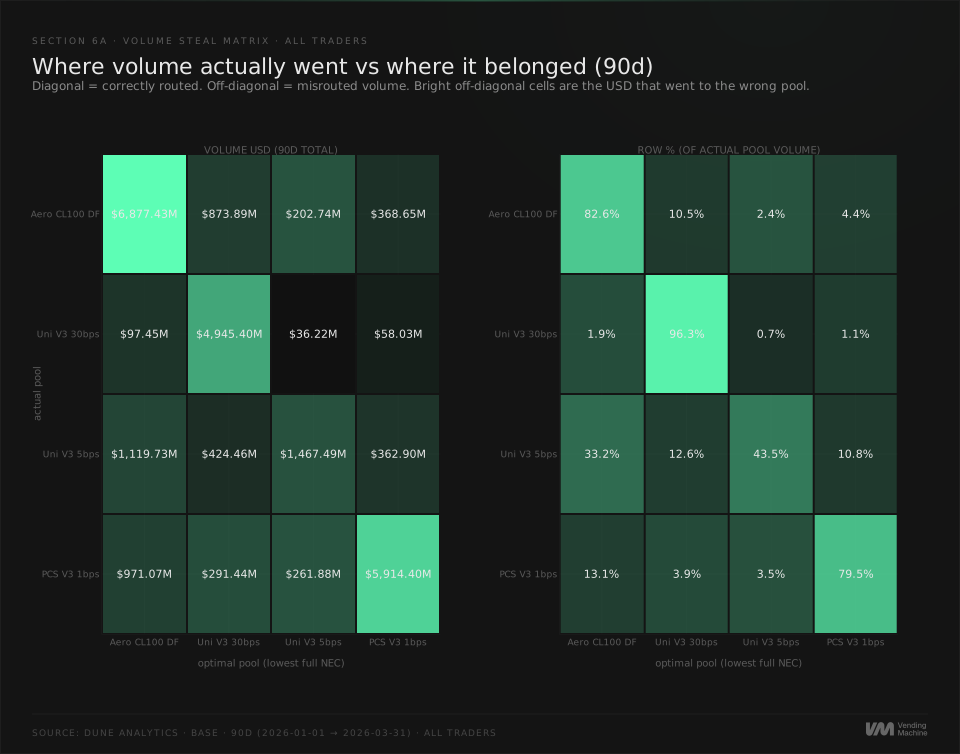
The routing accuracy data tells a subtler story. A "steal matrix" - showing where flow landed versus where it would have received best execution - reveals that the Uniswap 30 bps pool has the highest routing accuracy at 96.2%. Aerodrome's dynamic-fee pool sits at 82.6%, and PancakeSwap at 79.5%. The gap does not indicate avoidance of dynamic fees. Most misrouting runs from high-fee pools into low-fee pools. Those "stolen" trades produced less fee per dollar even at the optimal venue. The dynamic-fee pool captures flow that would otherwise scatter across multiple static tiers.
One caveat: survivorship bias is possible. Traders who experienced early failures may have migrated away from Aerodrome before the 90-day observation window. We cannot measure the counterfactual, and we flag it as an open question.
The data does not support the fee-volatility objection. Survivorship bias keeps the question open, and we will keep monitoring.
For LP strategists: dynamic-fee pools offer a strictly better reward profile than any single static tier. They also remove the need to split capital across tiers. For passive LP strategies, a dynamic-fee pool should be the default.
For protocol designers: the next problem is parameter optimization. Once a clAMM pool sits in a competitive slot, the parameters (, , , ) decide the outcome. The literature points toward online learning, and the authors flag arbitrage probability per block, benchmarked against fee rate and volatility, as the most tractable signal to optimize against.
For traders and aggregators: route by realized execution cost, not by nominal fee tier. Dynamic-fee pools will look expensive on some blocks and cheap on others. The routers that adapt will capture 1-3 bps of edge versus those that filter on static tier labels.
Static fee tiers were the right answer when concentrated liquidity was new and the design space was unmapped. That is changing. A single dynamic-fee pool, properly parameterized, captures more volume, generates more LP revenue, and delivers better execution than any static tier - or all of them combined. The open question is not whether dynamic fees win, but how fast the parameters can learn and be optimised for maximum performance.
Vending Machine builds analytics, research, and models for crypto protocols. We turn onchain data into design decisions: where fees are mispriced, where flow is leaking, where mechanism changes pay off.

Announcing our partnership with BIO, a new financial layer for decentralised science.
This report outlines the steps Vending Machine followed to simulate, validate and parameterise the token design that we proposed for Everclear.

Gauntlet's "Intro to AMM Incentives" provides an overview of the incentive mechanisms that AMMs adopt to attract liquidity and trading volume.

The introduction of EigenLayer and the resulting Actively Validated Services (AVS').

In this post, we aim to unpack what token design is and to demystify what token designers do.

Vending Machine is a boutique studio that designs tokens for pre-token projects.

A little about Vending Machine and its talented staff.
